Want More Businesses to Work for People? Buy One.
We have some pretty good ideas about how business can work. Employees can build wealth through ownership. Workers can have a real voice in decisions. Profits can fund a purpose beyond the people who hold the shares.
Now comes an interesting question: how do we get more businesses operating that way?
Acquisition belongs in that conversation.
If you have built a company around a different set of priorities, buying another business can extend those priorities to more people, more places, and more of the economy. An ownership model can be something you grow.
Your acquisition thesis can include who benefits
Buyers usually begin with industry, geography, revenue, and capabilities. Add another question: what should ownership make possible for the people in the business you acquire?
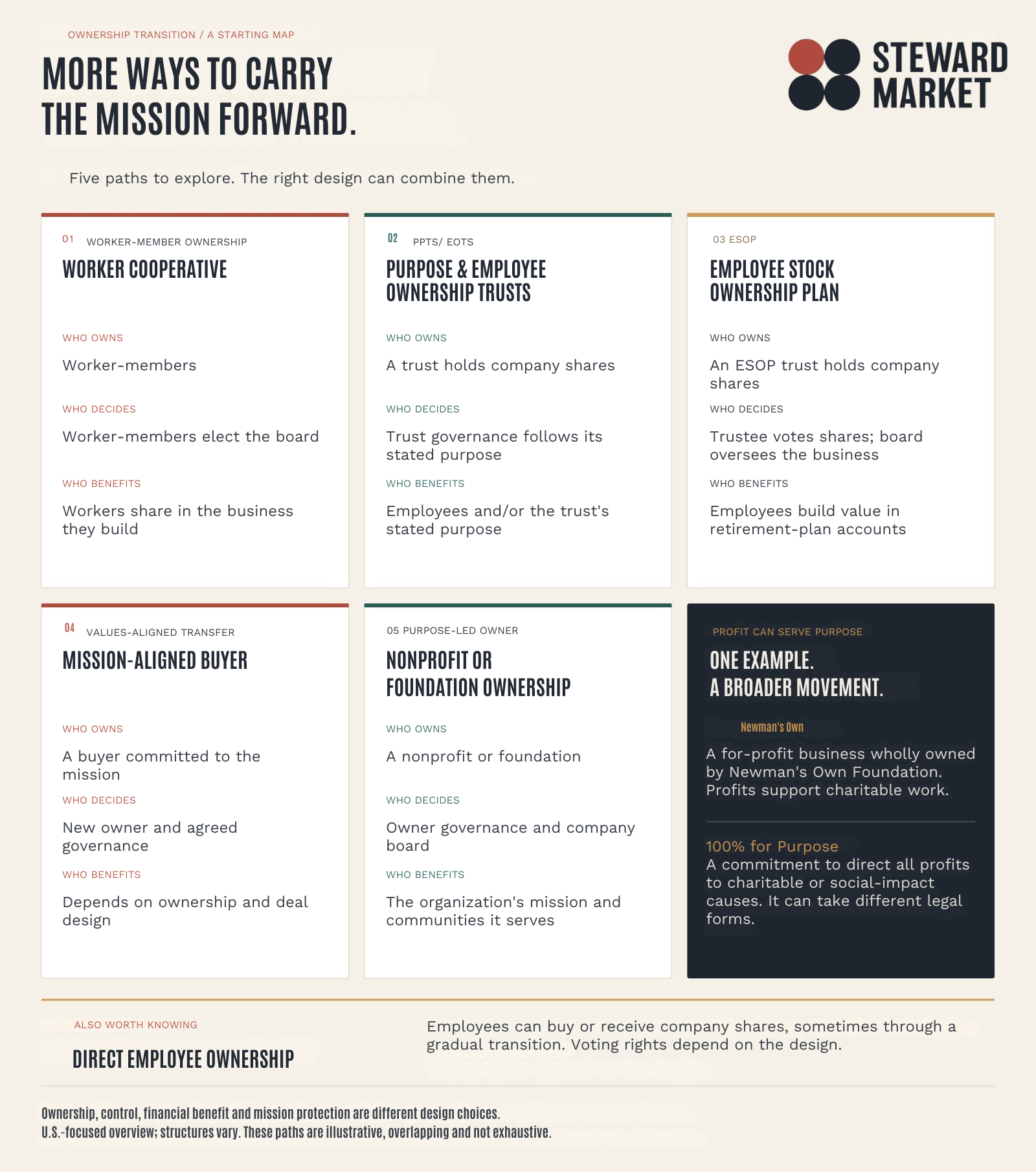
There are several ways to answer it:
A worker cooperative gives worker-members ownership and democratic control, generally on a one-member, one-vote basis.
A U.S. employee stock ownership plan, or ESOP, holds company shares in a retirement plan for employees. A trustee exercises shareholder rights, with employee voting rights generally limited.
A perpetual purpose trust can hold shares to protect a defined purpose. An employee ownership trust includes employee well-being among its purposes, with governance and benefit-sharing shaped by its design.
Direct employee ownership lets employees buy or receive shares directly. Eligibility, voting rights, and how people eventually sell their shares all need attention.
A mission-aligned operating company can also be the buyer, bringing its existing practices and commitments into another business. In every case, be specific about which employees participate, when they participate, and what they actually receive.
Profits can have a different destination, too
The 100% for Purpose movement brings together organizations directing all their profits to charitable or social-impact causes. That commitment can take different legal forms.
Newman’s Own makes one approach tangible: a for-profit food business wholly owned by a foundation, with profits supporting charitable work. Patagonia combines a purpose trust holding all voting stock with a nonprofit holding all nonvoting stock. Its excess profits, after reinvestment and reserves, support environmental work.
These models widen the imagination. They also raise practical questions for a buyer: could an acquisition expand the business that funds your mission? Who would hold the shares? What capital could support the purchase?
A founder donating ownership and a founder who needs sale proceeds face very different choices. The U.S. private-foundation exception associated with the Newman’s Own model requires ownership interests to be acquired other than by purchase. A profit commitment does not supply the money to buy a business. Bring qualified legal, tax, and financing professionals into the conversation early.
Acquisition is already expanding employee ownership
These models have deep roots as well as new possibilities. Some ownership structures have decades of history; creative adaptations and acquisitions can extend their reach.
Employee-owned 3LS, the parent of Omni Family of Services, shows what that can look like. In February 2025, 3LS announced its acquisition of marketing agency 5by5, taking the agency from partial ESOP ownership to 100% employee-owned. In March 2026, Omni announced its acquisition of JusticeWorks YouthCare, saying more than 600 employees would become employee-owners through the transaction.
For a deeper conversation about 3LS and what ownership can make possible, listen to Hannah Sandmeyer’s conversation with Corey Kupfer on DealQuest.
Phoenix Coffee offers another example. Evergreen Cooperatives’ Fund for Employee Ownership purchased the business in October 2020. In a 2023 explanation, Phoenix described a transition to worker ownership involving a repayment schedule, membership requirements, profit distributions, and employee-owner voting rights for board representation.
Different structures. A shared possibility: an existing business can become a place where more people participate in ownership.
The details matter enormously. Financial participation, voting power, and protection against a future sale are separate choices. Each deserves a clear answer.
Those choices can also be visible before a deal. This anonymous ESOP holding-company buyer on Steward Market describes a 100% S-corp ESOP structure and a permanent-hold approach. A profile like that gives owners something specific to explore with a prospective buyer.
Give a founder something concrete to believe in
“We care about your people” is an easy sentence to put in an acquisition email. A serious buyer should be ready for the next questions:
Who will own and govern the business after closing?
What happens to employees’ jobs, benefits, voice, and opportunities to build wealth?
Can the financing support those commitments while funding the business’s ongoing needs?
What protects the mission if leadership, investors, or ownership changes again?
Who is responsible for making the transition work, and how will progress be measured?
Work through those questions before approaching owners. They help you recognize a business you can genuinely support, explain your intentions, and find the places where your plan still needs work.
Then go looking beyond businesses already advertised for sale. An owner may be open to a conversation with a buyer who can describe a future worth considering. You have to find each other first.
That is where Up & Over’s buy-side sourcing work comes in: finding businesses and starting conversations around what a purpose-led buyer wants to build.
Want to grow your mission, your employee-ownership model, or the business that funds your purpose through acquisition?